Sensory Budget: a neuro-affirming approach to intimacy and sensory overwhelm

Tell me why you sometimes you want to be so close to your partner that you try to crawl inside their skin, and then other days the mere sound of them chewing sends you spiralling into a pit of rage and despair?
Sensory budget explained:
Well, everybody has what we call a Sensory Budget, which is a way of looking at your nervous system’s capacity as a daily finite resource. Certain tasks, activities or environments will drain your sensory budget - and others will replenish it.
If you push yourself beyond your budget in a day, you’ll likely find yourself in a meltdown or shutdown. Burnout and a healthy, fulfilling intimate life do not go hand in hand.
So it’s really important to figure out where your resources are being used, and how you can adjust your lifestyle, habits and schedule to protect your sensory budget from being repeatedly drained.
Everyone has a sensory budget, even neurotypical people. It just happens that neurodivergent people can more easily get pulled into overwhelm or shutdown.
On some days you might be hypersensitive, when you’re feeling overwhelmed, overstimulated and even the lightest touch can feel painful or annoying.
Or you might be hyposensitive, when you’re feeling disconnected, and you need firm touch or pressure to come back into your body.
It’s not just touch that contributes to this budget, it’s all your senses combined.
So consider sounds, smells, tastes, lights and other textures.

Things that might deplete your sensory budget:
Loud, busy places
Bright, fluorescent lights
A messy, cluttered house
Barking dogs
Kids climbing all over you all day
A tag on your clothing

Things that might replenish your sensory budget:
Quiet, alone time
Lifting heavy weights
A walk in nature
Being in water - a bath or swim
Weighted blanket with noise-cancelling headphones
Dancing, laughing, playing
Intimacy and neurodivergence
Different nervous systems require different pathways to sustain connection. Neurodivergence isn't always one neat set of needs. You can genuinely want two seemingly contradictory things at once.
i.e. “I want more affection from my partner, but I don’t want to be touched.”
By understanding your unique sensory landscape and building up skills that fit your nervous system, you can be equipped with a toolbox of skills and language to recognise and communicate when you’re moving in and out of connection and disconnection.
One reason that a neurodivergent nervous system can deplete its sensory budget so much more rapidly than a neurotypical person is that neurodivergent people often struggle to habituate to sensory input. Where a neurotypical person may automatically drown out the multiple conversations in a busy café into something they call ‘background noise’ – neurodivergent people may experience every noise in the café (including the conversation they’re trying to engage in) at the same volume.
Another example is the feeling of clothes or jewellery on the skin. For neurodivergent people, this can feel like relentless scratching and discomfort, rather than a sensation their body simply ‘gets used to’ over time.
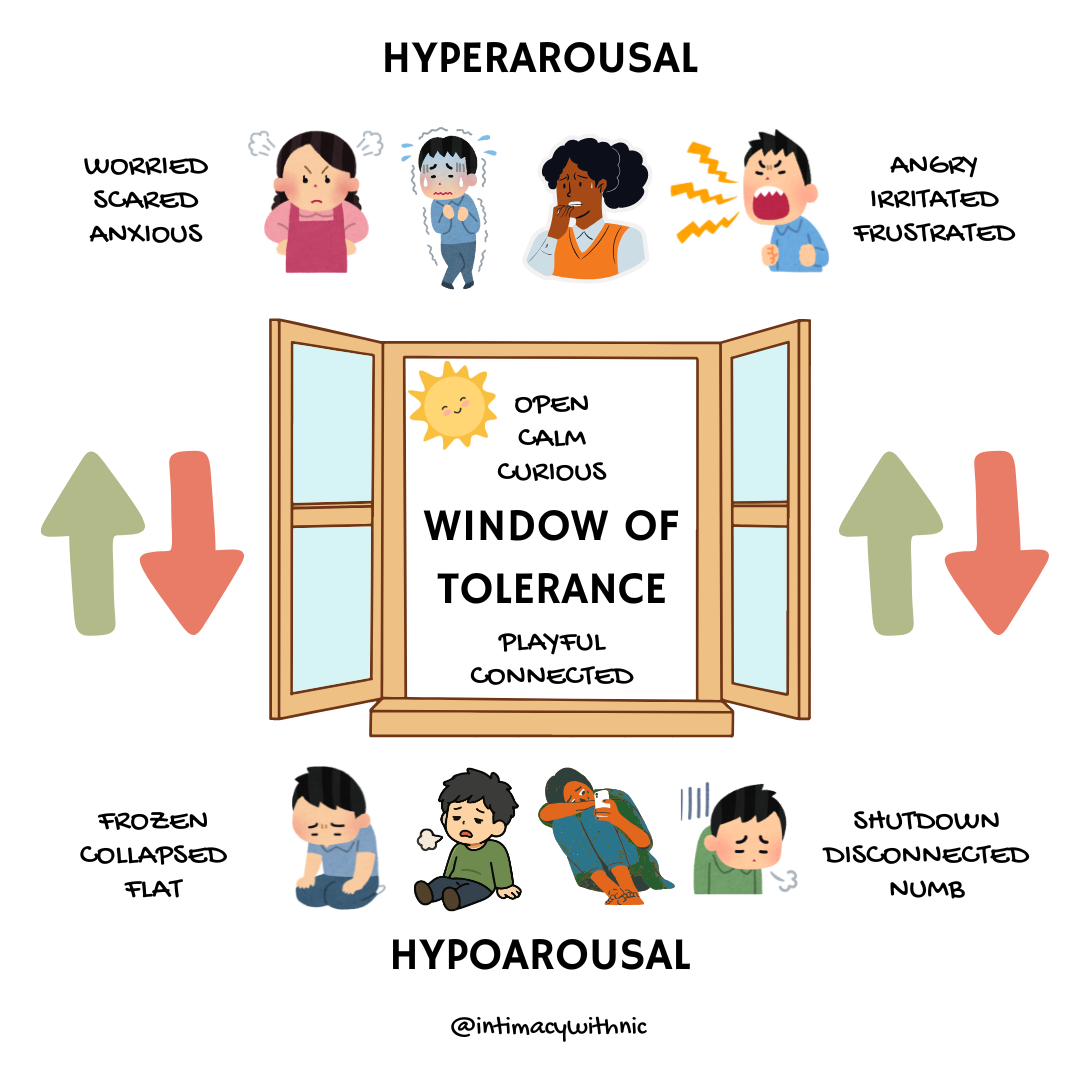
Autonomic nervous system and the Window of Tolerance
Our autonomic nervous system is constantly asking, “Am I safe?”
To connect with others and feel desire, we need to be in a state of regulation. But what does that even mean?
Essentially, we have three states of the autonomic nervous system that we move through constantly, depending on how much safety or danger our body perceives we are in.
Emphasis on "perceives," as we may not actually be in danger, but our body has detected something it considers a threat and has moved into a trauma response.
Hyperarousal is what you may have heard referred to as "fight or flight", and Hypoarousal is a shutdown or collapse. The Window of Tolerance is the sweet spot in the middle where you can comfortably regulate your emotions and are open to connection.
How this relates to sex and intimacy
Shutting down or pulling away from intimacy is your nervous system trying to protect you.
We often don’t realise we’re about to have a meltdown or shutdown until it’s happening. We miss the early warning signs, and now we’re on the fast track to disconnection with no off-ramp available.
So how can we start to notice when we’re on our way? How can we build awareness in our nervous system state before we exit the window of tolerance?
Instead of analysing our feelings, notice what’s happening in your body and the environment you’re in. What is the story being told by your nervous system?
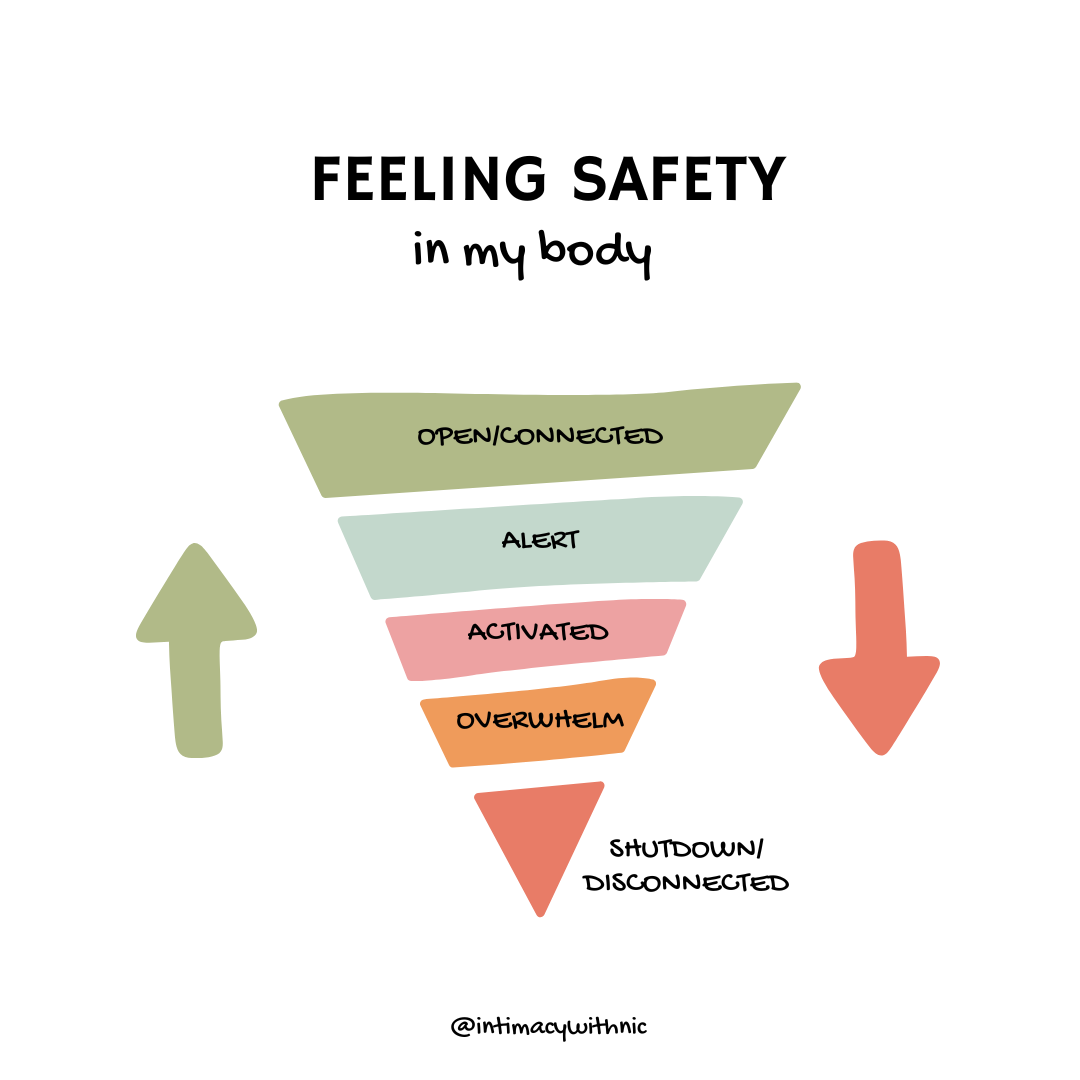
Exercise
Write a list with two columns answering the below.
What helps you move towards feeling more open to connection? (arrow pointing up)
e.g. movement, pressure, music, silence, alone time, talking, eye contactIt’s not always about calming down. Often when you’re at shutdown, you need gentle movement, sound and connection to bring you back, rather than slow breathing.
What makes you move towards overwhelm and disconnection? (arrow pointing down)
e.g. messy room, loud noises, too much touch too fast, talking, eye contact
Notice how talking and eye contact could move you both towards and away from connection? Every nervous system is different, and the same person may react to a certain stimulus differently on different days, depending on the surrounding context.
Now imagine your sensory budget as a money bank. Each day you start with a certain amount, maybe some days it’s $100 and some days it’s $30.
Start to allocate amounts to certain sensory input, e.g., fluorescent lights = $15, screaming kids = $30. If you know you’re going to be sitting in a busy waiting room for half an hour that will likely have fluorescent lights and screaming kids, you may be spending $45 of your sensory budget just on that half hour.
What happens to you when your sensory cup starts to reach full? How do you know when you’re about to reach overwhelm?
By noticing what happens for you as you move through each of these stages, you’ll start to build an awareness in your body that allows you to say, “Hey, I’m feeling activated. I just need to remove myself from this environment or remove some sensory input so I don’t enter overwhelm or shutdown.”
This can be useful during intimacy too.
If you’re trying to be intimate but are in an environment that is draining your sensory budget, notice what you can change around you.
Can you dim the lights? Turn down the music? Wear a blindfold to reduce visual input? Wear earplugs to reduce auditory input?
Or do you need a different type of touch or a break from touch completely? There is no wrong answer.
There is nothing wrong with needing accommodations during sex so that you can be more present and in the moment. It’s totally normal and encouraged to express your needs, rather than trying to push through discomfort.
You are wonderful!

Hey, I’m Nic
I’m a somatic sexologist and relationship coach, passionate about providing neuro-affirming support to individuals and people in relationships.
I hope this information has helped you to understand yourself and your needs a little better.
I’d love to hear from you, so please leave some feedback via the form below. Or get in touch via my contact page if you’d like to chat about working together.